
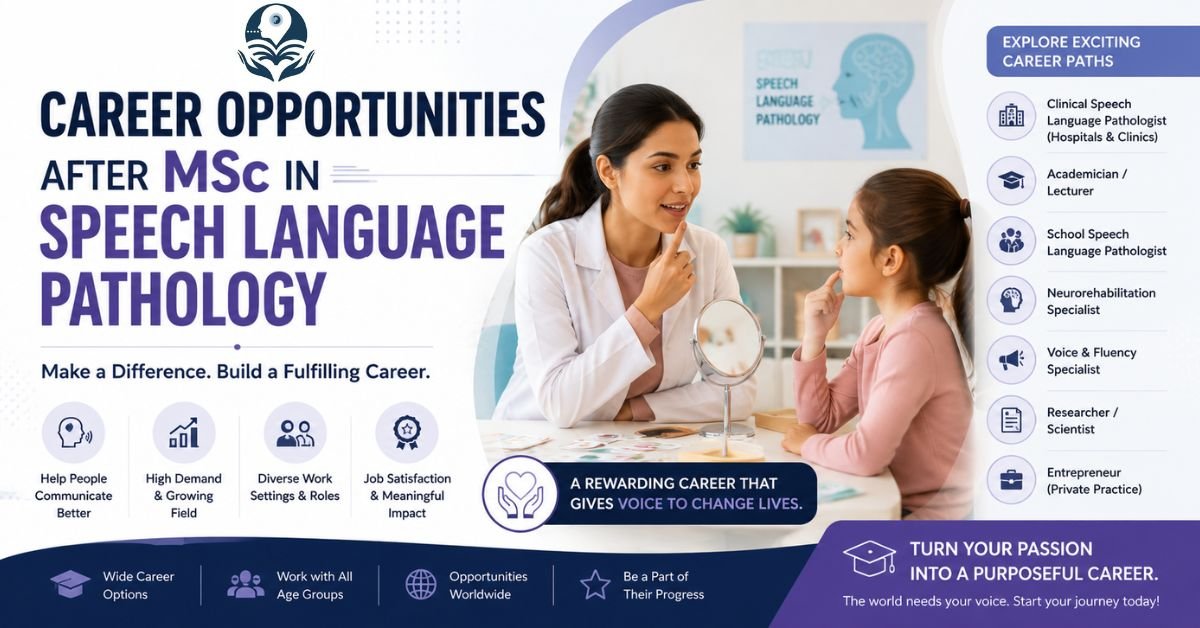
The Day Priya Found Her Voice And Her Career
Priya was 22 when she walked into her first clinic placement. She had just completed her first year of the MSc in Speech-Language Pathology and was still unsure whether she had made the right choice. Then she met a seven-year-old boy who hadn’t said a full sentence in his life. Three months later, he called his mother by name for the first time.
That moment, Priya will tell you, is why she chose this field. And that moment is also why thousands of students across India are now asking the same question she once did: what exactly can I do with an MSc in Speech-Language Pathology after I graduate?
The answer is far bigger than most people expect. The MSc Speech-Language Pathology program at MERF Institute of Speech and Hearing in Tamil Nadu is one of the most rigorous and respected pathways into this profession in South India. Graduates step out not just with a degree, but with clinical competence, research exposure, and the kind of field experience that opens doors across hospitals, schools, rehabilitation centres, private practice, and even the tech industry. This blog walks you through every major speech-language pathologist job avenue available to you with stories, scope, and honest insight.
1. Clinical Speech-Language Pathologist in Hospitals
The most traditional and well-recognised career path is working as a clinical speech pathologist in a hospital setting. Neurology departments, ENT wards, paediatric units, and intensive care teams all depend on SLPs to assess and treat patients with communication and swallowing disorders.
When Rajan, a 58-year-old software professional, suffered a stroke, he lost the ability to speak fluently. His family was terrified. The hospital SLP just three years out of her MSc programme worked with him five days a week on aphasia rehabilitation. Within four months, he was holding full conversations. His family said she gave him back his identity.
Hospital roles typically offer structured salary scales, growth into senior therapist positions, and the opportunity to build specialisations in areas like neurological speech disorders treatment, dysphagia management, and voice rehabilitation. Government hospitals, corporate hospital chains like Apollo and Fortis, and multispecialty clinics all recruit SLP graduates actively.
If this path interests you, explore the MSc SLP curriculum at MERF to understand how the clinical training prepares graduates for exactly this kind of high-stakes, high-impact work.
2. Paediatric Speech Therapist in Schools and Early Intervention Centres
One of the fastest-growing areas of SLP career opportunities in India is paediatric practice. With rising awareness around autism spectrum disorder, developmental delays, and language learning difficulties, schools and early intervention centres are actively seeking trained speech-language pathologists.
Deepa started her career in a special education school in Chennai. Every morning, eight children between the ages of three and ten would wait outside her therapy room. Some had autism, some had hearing loss, some simply had late language development that no one had caught early enough. Deepa’s job wasn’t just therapy it was hope delivered thirty minutes at a time.
Paediatric SLP roles demand patience, creativity, and the ability to communicate with both children and anxious parents. The scope here extends beyond therapy rooms too many paediatric SLPs work as consultants to playschools, design home training programmes, and collaborate with occupational therapists and psychologists in multidisciplinary teams.
3. Audiology and Speech Therapy Clinics Private Practice
Running your own practice or joining an established audiology and speech therapy clinic is a dream many SLP graduates work toward by their fifth year of professional experience. Private practice in India offers significant earning potential, schedule flexibility, and the ability to build long-term therapeutic relationships with clients.
The speech therapist job scope in private settings includes everything from early childhood intervention to adult voice therapy and accent modification for corporate professionals. In metro cities like Chennai, Bengaluru, Hyderabad, and Mumbai, experienced SLPs in private practice often earn substantially more than their hospital counterparts, particularly those who also offer online sessions.
Starting a practice requires business acumen alongside clinical skill and this is precisely why top programmes like the MSc SLP at MERF emphasise real-world clinical internships that expose students to diverse client needs and practice management realities.
4. Academic and Research Careers in Speech Pathology
If classrooms and laboratories spark your curiosity as much as clinics do, an academic career in speech pathology might be your destination. After completing an MSc in Speech-Language Pathology, you can pursue a PhD, contribute to cutting-edge research on communication disorders, and join teaching faculty at universities and institutes.
India has a significant gap in SLP research output compared to global standards, which means this space is rich with opportunity for those willing to fill it. Research areas that are particularly active include augmentative and alternative communication (AAC), motor speech disorders, bilingual language development, and the neuroscience of language.
SLP research opportunities in India are growing steadily, supported by government bodies like the Indian Council of Medical Research and organisations aligned with the Rehabilitation Council of India. Academic faculty positions at institutions offering ASLP courses in Tamil Nadu and across the country are also increasingly available as the field expands its institutional footprint.
5. Rehabilitation Centres and NGO Sector
Not every SLP career is driven by salary benchmarks. Some graduates choose paths defined by impact and nowhere is that more visible than in rehabilitation centres and NGOs working with underserved communities.
Vikram chose a different road. After finishing his MSc SLP, he joined a rural rehabilitation NGO in Tamil Nadu that served children with disabilities in villages that had never seen a speech therapist. He travelled. He trained local volunteers. He created visual communication tools in the local language. He once worked with a teenager who had never been formally diagnosed with anything just written off as slow — and discovered the child had a severe but entirely treatable articulation disorder.
Speech therapy rehabilitation jobs in the NGO sector may offer lower starting salaries but often include training support, accommodation, and the kind of professional development that fast-tracks your skills. They also increasingly come with international exposure as global development organisations partner with Indian NGOs on community health programmes.
6. Corporate Sector – Voice Training, Accent Coaching, and Workplace Communication
Here is a career path that surprises most people outside the field. A growing number of SLP graduates are building careers in corporate voice training, executive communication coaching, and accent modification services for BPO employees and multinational professionals.
India’s IT and business process industry employs millions of professionals who benefit from structured voice and communication training. Communication disorders specialists with an SLP background are uniquely qualified to design and deliver these programmes far more so than generic trainers without clinical grounding.
This path often starts as a side consultancy and grows into a full-time venture. Several MERF alumni have found their way into this niche, and it represents one of the more financially rewarding SLP career opportunities in India for those comfortable blending clinical expertise with corporate communication needs.
7. Online Speech Therapy The Digital Career Frontier
The pandemic changed everything for telehealth and speech therapy was no exception. Online speech therapy careers have grown dramatically since 2020, and the infrastructure now exists for SLPs to build sustainable, scalable practices entirely in the digital space.
Meena moved to Singapore with her spouse two years after completing her MSc SLP at MERF. Rather than retrain or accept a career pause, she built an online practice serving clients across India, Singapore, and the UAE. She works with children in Mumbai, adults recovering from strokes in Coimbatore, and corporate clients refining their presentation skills in Dubai all from a single room with a good microphone and a reliable broadband connection.
Online speech therapy careers require the same clinical competence as in-person practice, but add layers of digital literacy, platform management, and remote client engagement. They also open international markets to Indian SLPs in a way that was simply not possible a decade ago.
8. Government Sector and Policy Roles
SLP graduates with an interest in systemic change can pursue positions within government health departments, disability commissions, and policy bodies that shape how communication disorders are identified, funded, and treated at the national level.
The Rehabilitation Council of India (RCI) certifies SLPs and also offers pathways into administrative and advisory roles. State health departments in Tamil Nadu, Karnataka, Kerala, and Maharashtra have been expanding their allied health workforces, creating openings for SLPs in district hospitals, community health centres, and government schools under inclusive education mandates.
Government positions typically offer job security, pension benefits, and a structured progression path making them an attractive option for SLP graduates looking for stability alongside purpose.
9. International Career Opportunities for Indian SLPs
Indian SLP graduates are increasingly finding opportunities abroad particularly in the United Kingdom, Australia, Canada, and the Gulf countries. Countries with English as a first or official language have active demand for qualified SLPs, and MERF-trained graduates often have the clinical depth and academic rigour that international licensing bodies recognise.
International SLP careers typically require credential verification, language proficiency certification, and in some cases a supervised period of practice. The process can take one to two years, but the returns both financial and professional are significant. Speech pathologist salary in India ranges from ₹25,000 to ₹60,000 per month for experienced clinicians. In the UK or Australia, that figure can be three to five times higher.
If international practice is your goal, building a strong clinical foundation through a recognised programme like the MSc SLP at MERF Institute is the right starting point. The programme’s emphasis on evidence-based practice aligns well with international accreditation standards.
10. Technology and Assistive Communication Design
Perhaps the most forward-looking career path available to SLP graduates today is at the intersection of speech science and technology. Assistive communication devices, AAC apps, voice analysis software, and AI-driven speech therapy platforms all need the clinical knowledge that MSc SLP graduates possess.
Technology companies building products for people with communication disorders from nonverbal autism support apps to post-laryngectomy voice restoration tools need SLPs on their teams as clinical consultants, product designers, and user experience advisors. This is a genuinely emerging field in India and globally, and it rewards early movers who are willing to bridge clinical practice with product thinking.
SLP research opportunities in India increasingly include collaborations with engineering departments and health-tech startups, making this an accessible path for graduates who combine their clinical MSc with even basic familiarity with app design or data analysis.
Track Your Learning and Career Progress
Building a career in speech-language pathology is not a sprint. It is a structured, ongoing process of clinical hours, continuing education, skill development, and professional networking. Tracking your growth consistently from your first placement to your hundredth clinical session makes a measurable difference in how fast you build confidence and competency.
Whether you use a digital journal, a progress tracking app, or a structured logbook, consistent self-monitoring helps you identify your strengths, recognise skill gaps, and set meaningful milestones. Many successful SLPs describe the habit of tracking their activity client sessions, professional development hours, supervision notes, and career goals as one of the most underrated tools in their professional growth.
Apps that track your professional activity are particularly useful during the internship and early career phase. Just as apps like MyStreakBook are designed to build consistent daily habits through gamified tracking turning abstract goals into measurable daily streaks the same principle applies to your clinical career. Tracking your sessions, your CPD hours, your networking touchpoints, and your skills development with the same discipline you would apply to a fitness routine will compound into exceptional career outcomes over time. Start building that habit from day one of your MSc SLP programme at MERF.
Final Thoughts:
Every career path described in this article traces back to the same origin story: a human being who could not communicate, and a trained professional who helped them find a way. That is what speech-language pathology is, at its core. Not a career of paperwork and protocols — though those exist — but a career built on the irreplaceable act of helping people connect with the world and the people they love.
If you are standing at the beginning of this journey, or advising someone who is, the MSc in Speech-Language Pathology at MERF Institute of Speech and Hearing offers one of the most credible, clinically rigorous, and professionally respected foundations you can build on. The career opportunities after MSc in Speech-Language Pathology are vast, varied, and growing every year as India’s healthcare ecosystem matures and awareness around communication disorders deepens.
The question is not whether there are opportunities. There are. The question is which one calls to you most clearly — and whether you are ready to answer.
FAQs:
1Q: What is the salary of a speech-language pathologist in India after MSc?
A: Entry-level SLPs in India typically earn between ₹20,000 and ₹35,000 per month in hospital or clinic settings. With 3–5 years of experience, this rises to ₹40,000–₹70,000 monthly. Private practitioners, corporate voice trainers, and online SLPs often earn significantly more, depending on client volume and specialisation. Those who pursue international careers can earn three to five times the domestic average.
2Q: Can I work abroad after completing MSc SLP from MERF?
A: Yes. Many MERF MSc SLP graduates have pursued international careers in the UK, Australia, Canada, and the Gulf. The process involves credential verification, language proficiency testing (typically IELTS or OET), and meeting the requirements of the host country’s licensing body. The rigorous clinical training at MERF is well-regarded and aligns with international evidence-based practice standards. Plan for a one to two year credential verification process before employment abroad.
3Q: Is private practice viable for an SLP in India in the early years?
A: Starting your own speech therapy practice directly after graduation is possible but challenging. Most SLPs spend two to four years building clinical experience and professional networks in hospital or clinic settings before transitioning to private practice. Those who do make the move early benefit from starting part-time, building referral relationships with paediatricians and neurologists, and combining in-person and online sessions to manage overheads. The MERF clinical internship programme gives graduates a strong foundation for understanding real-world practice management.
4Q: What specialisations can I pursue after my MSc SLP?
A: After completing your MSc, you can specialise through clinical experience and continuing professional development in areas including paediatric language and speech disorders, neurological rehabilitation (aphasia, dysarthria, dysphagia), voice disorders, augmentative and alternative communication (AAC), fluency disorders (stammering), and craniofacial anomalies. Some graduates also pursue a PhD to enter academic or advanced research roles. International certification programmes in specific specialisations are also accessible.
5Q: How does the MERF MSc SLP programme prepare graduates for diverse careers?
A: The MSc Speech-Language Pathology programme at MERF Institute of Speech and Hearing combines comprehensive academic coursework with structured clinical placements across multiple settings including hospitals, schools, rehabilitation centres, and community health environments. This breadth of exposure ensures graduates can navigate different professional contexts with confidence. The programme emphasises evidence-based practice and research literacy, which prepares graduates equally for clinical careers, academic roles, and the growing number of technology-facing opportunities in the field. Explore the full programme at merfish.org
Published by MERF Institute of Speech and Hearing | merfish.org
© 2025 MERF Institute. All rights reserved.