
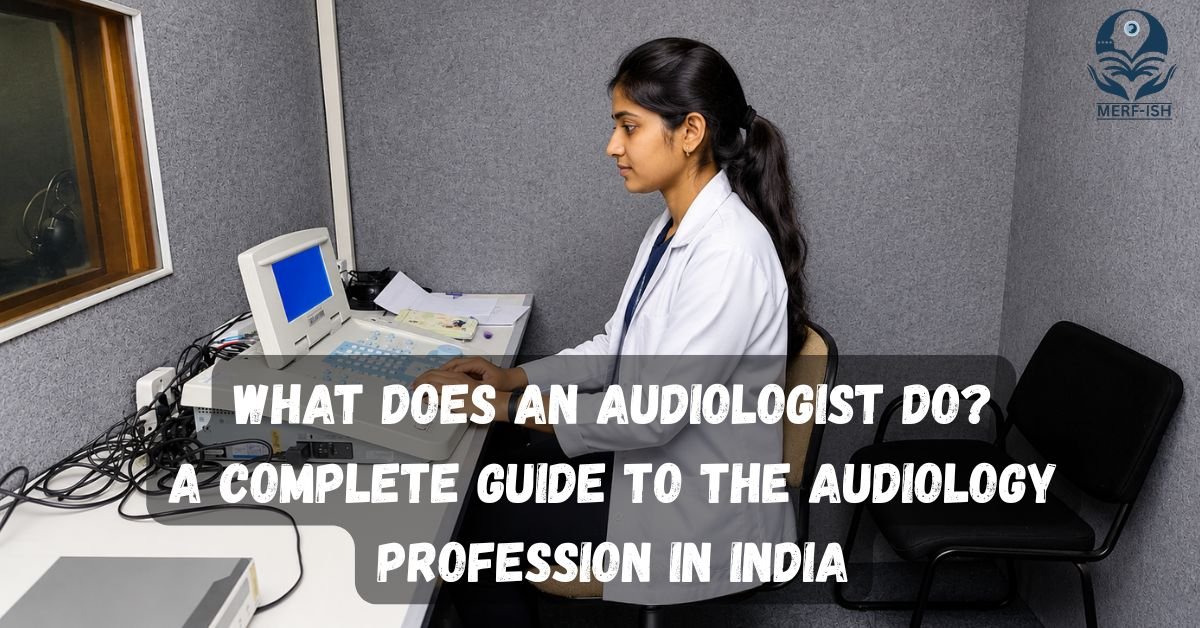
Most people have heard of ENT doctors. Far fewer have heard of audiologists — even though audiologists are often the professionals who actually diagnose and rehabilitate hearing conditions that ENTs refer out.
In India, audiology remains one of the most underrepresented healthcare professions relative to the scale of need. Over 63 million Indians are estimated to live with significant hearing impairment. Cochlear implant surgeries are rising. Newborn hearing screening is expanding to district hospitals under national health programmes. And yet, the number of trained audiologists in the country falls well short of what is required.
This guide explains what audiologists actually do — not in textbook terms, but in plain, practical language. Whether you are a student figuring out your career path, a parent exploring options for a child with hearing difficulties, or a BASLP graduate considering postgraduate study, this should give you a clear picture.
If you are specifically looking at MSc Audiology as a postgraduate option, the MERF Institute MSc Audiology page gives a detailed breakdown of the programme and eligibility.
Who Is an Audiologist?
An audiologist is a healthcare professional trained to evaluate, diagnose, and manage disorders of the auditory and vestibular systems — in simpler terms, hearing loss and balance problems.
They are not surgeons. They do not prescribe medication. What they do is assess the type and degree of hearing or balance dysfunction, determine the most appropriate intervention, and either provide that intervention directly (such as fitting a hearing aid or mapping a cochlear implant) or guide the patient to the right specialist.
In India, audiologists must be registered with the Rehabilitation Council of India (RCI) to practise clinically. This registration requires a formal audiology degree — either a BASLP (Bachelor of Audiology and Speech Language Pathology) or a dedicated B.Sc. in Speech and Hearing, followed optionally by an MSc in Audiology for specialist roles.
What Does an Audiologist Actually Do? (Day-to-Day Work)
The day-to-day work of an audiologist depends on their setting, but here is what the job typically involves across different environments:
Diagnostic Assessments
This is the core of the profession. Audiologists conduct a range of tests to assess hearing function:
• Pure Tone Audiometry (PTA) — the standard test that produces an audiogram showing hearing thresholds across frequencies
• Tympanometry — measures the movement of the eardrum and middle ear function
• Otoacoustic Emissions (OAE) — used primarily in newborn and paediatric screening
• Auditory Brainstem Response (ABR / BERA) — assesses the neural pathway from the ear to the brainstem, used for infants, non-cooperative patients, or medico-legal cases
• Auditory Steady-State Response (ASSR) — used for objective threshold estimation, especially in young children
• Speech Audiometry — assesses how well a person hears and understands speech
Hearing Aid Fitting and Rehabilitation
Audiologists are the professionals who select, programme, and fit hearing aids. This is not simply picking a device off a shelf. It involves real-ear measurement, audiogram-based fitting targets, verification of the fitting, and ongoing follow-up to adjust the device based on patient feedback. The app will track your activity related to hearing aid usage and rehabilitation appointments, helping patients stay on schedule with their audiologist visits.
Cochlear Implant Programming
In cochlear implant centres, audiologists play a crucial role post-surgery. They conduct the implant mapping sessions — programming the device based on the patient’s neural responses — and manage long-term rehabilitation. This is a highly specialised sub-field that requires advanced training, and qualified cochlear implant audiologists are in short supply across India.
Vestibular (Balance) Assessment and Rehabilitation
Balance disorders — dizziness, vertigo, chronic imbalance — are often rooted in vestibular system dysfunction. Audiologists trained in vestibular assessment conduct tests such as Videonystagmography (VNG) and Vestibular Evoked Myogenic Potential (VEMP) to diagnose these conditions, and provide vestibular rehabilitation therapy (VRT) for appropriate cases.
Newborn and Paediatric Hearing Screening
Universal Newborn Hearing Screening (UNHS) is now a national priority in India. Audiologists conduct OAE and ABR-based screenings in hospitals, NICU settings, and community programmes to identify hearing loss as early as possible — because early identification directly improves outcomes for children.
Disability Certification
Under the Rights of Persons with Disabilities Act, 2016, registered audiologists are authorised to assess and certify hearing disability for official government records. This certification determines eligibility for welfare benefits, educational accommodations, and assistive device schemes like ADIP.
Audiologist vs ENT Doctor — What Is the Difference?
This is one of the most commonly asked questions, and it is worth being precise about.
| Audiologist | ENT Doctor (Otolaryngologist) |
| Allied health professional | Medical doctor (MBBS + specialisation) |
| Diagnoses and rehabilitates hearing/balance disorders | Diagnoses and surgically treats ear, nose, throat conditions |
| Cannot prescribe medication or perform surgery | Can prescribe medication and perform surgery |
| Fits hearing aids, maps cochlear implants, provides VRT | Performs cochlear implant surgery, ear surgeries |
| Certified by RCI in India | Certified by Medical Council of India |
ENTs and audiologists work in close partnership in most hospital settings. The ENT determines whether a medical or surgical intervention is required. The audiologist handles the diagnostic workup and all non-surgical rehabilitation. A patient with sensorineural hearing loss, for instance, would be diagnosed by an audiologist, and the ENT would confirm that no surgical intervention would change the outcome — after which the audiologist takes over the rehabilitation pathway.
Audiology vs Speech Therapy — Are They the Same?
No — though both professions share an undergraduate foundation in many Indian programmes (the BASLP degree covers both). The distinction matters when choosing a postgraduate specialisation or a career direction.
• Audiology is focused on hearing, balance, and the auditory system — diagnosis, intervention, and rehabilitation of hearing disorders.
• Speech Language Pathology (SLP) is focused on communication disorders — speech, language, fluency, voice, and swallowing.
An audiologist who wants to specialise will pursue an MSc Audiology. An SLP who wants to specialise will pursue an MSc SLP. The two degrees are distinct, though graduates of both work in overlapping clinical settings.
The easiest way to think about it: if your patient has a problem hearing, they need an audiologist. If they can hear but have difficulty communicating, they need a speech language pathologist.
How to Become an Audiologist in India
The pathway is structured and regulated by the Rehabilitation Council of India:
| Step | Qualification | Duration |
| 1 | 10+2 with Physics, Chemistry, Biology (minimum 50%) | — |
| 2 | BASLP or B.Sc. Speech & Hearing (RCI-recognised) | 4 years |
| 3 | RCI Registration as Audiologist | Post-graduation |
| 4 | MSc Audiology (optional, for specialist roles) | 2 years |
| 5 | PhD in Audiology (optional, for academic/research) | 3+ years |
Students who complete their BASLP and register with RCI are eligible to practise as audiologists in clinical, hospital, and community settings. The MSc is not mandatory to start working — but it is required for specialist roles, teaching positions, and government job grades that demand postgraduate qualifications.
For those considering the MSc route, the MERF Institute MSc Audiology programme is a well-regarded option in South India with RCI recognition and strong clinical infrastructure.
Types of Audiology Specialisations in India
Audiology is not a monolithic field. As the profession matures in India, specialisation pathways are becoming clearer:
Paediatric Audiology
Working with infants, toddlers, and school-age children — newborn screening, early intervention, BERA-based diagnosis, hearing aid fitting for children, and school hearing programmes.
Cochlear Implant Audiology
Pre-operative candidate assessment, post-surgical implant programming, and long-term mapping and rehabilitation. This sub-specialty requires additional training and is concentrated in tertiary cochlear implant centres.
Vestibular Audiology
Diagnosis and rehabilitation of dizziness and balance disorders. VNG, VEMP, and cVEMP testing, combined with vestibular rehabilitation therapy. One of the least served sub-specialties in India despite high patient need.
Industrial and Occupational Audiology
Hearing conservation programmes in factories, construction sites, and industries where noise exposure is high. Includes baseline audiometry, annual monitoring, and noise-induced hearing loss prevention.
Forensic Audiology
Medico-legal hearing assessments — used in disability certification, insurance claims, and legal proceedings requiring objective evidence of hearing function or loss.
Geriatric Audiology
Hearing management for older adults — age-related hearing loss (presbycusis), hearing aid candidacy, and communication strategies for elderly patients. Growing rapidly as India’s population ages.
Where Do Audiologists Work in India?
The settings vary, and so do the day-to-day responsibilities:
• Government hospitals and ENT departments (AIIMS, NIMHANS, ESIC hospitals, state district hospitals)
• Private multi-specialty hospitals with dedicated audiology and cochlear implant units
• Hearing clinics and hearing aid dispensing centres
• Speech and hearing institutes (standalone institutions like MERF)
• Rehabilitation centres for children and adults with disabilities
• Special schools for hearing-impaired students
• NGOs running community hearing screening and intervention programmes
• Medical colleges and universities (as faculty/researchers)
• Defence establishments (Army, Navy, Air Force medical services)
Institutions like MERF Institute of Speech and Hearing provide both clinical services and academic programmes — giving students hands-on exposure to real patient workloads as part of their training.
Audiology Career for BASLP Graduates — What Are the Options?
If you have completed a BASLP and are figuring out where to go next, here is an honest breakdown:
Option 1: Direct Clinical Practice
With RCI registration, you can start working in hospitals, hearing clinics, or rehabilitation centres immediately after your BASLP. Many graduates do this and build solid clinical experience before deciding on further study.
Option 2: MSc Audiology
Pursuing an MSc gives you access to specialist clinical roles, teaching positions, and government posts that require postgraduate qualifications. It also deepens your diagnostic and technical skills significantly — cochlear implant mapping, vestibular assessment, and advanced audiological rehabilitation are typically not fully covered at the undergraduate level.
Option 3: MSc SLP
If your interest during BASLP was more on the speech and language therapy side — working with children who have language delays, adults recovering from stroke, or patients with voice disorders — MSc SLP is the natural path.
Option 4: PhD in Audiology
For those drawn to academic careers, research, or policy, a PhD after MSc opens up faculty roles, research fellowships, and leadership positions in institutions and government programmes. The app will track your activity through academic milestones, so keeping a log of your research output and publications from early on helps build a strong PhD portfolio.
There is no universally correct path — the right choice depends on where your clinical interests lie and what kind of work environment you want to be in five years from now.
Final Thoughts
The audiology profession in India is at an interesting inflection point. Healthcare infrastructure is expanding into tier-2 and tier-3 cities. Government screening programmes are creating demand for field-level audiologists. Cochlear implant services are growing in both the public and private sectors. And the awareness gap — the fact that most people still do not know what an audiologist does — is slowly closing as hearing health enters mainstream healthcare conversations.
If you are someone who is drawn to diagnostic work, enjoys working with technology, and wants a clinical career that genuinely changes people’s lives — often in ways that are visible and immediate — audiology is worth serious consideration.
And if you are already a BASLP graduate looking to take the next step, an MSc Audiology from a credible, RCI-recognised institution is one of the clearest routes to a specialist career in this field.
To explore the MSc Audiology programme, eligibility, and admission process, visit theMERF Institute MSc Audiology page. For a full overview of all programmes offered — including BASLP, MSc SLP, PGDAVT, and PhD — visit theMERF Institute homepage.
Frequently Asked Questions (FAQs)
1. Is an audiologist a doctor?
No. In India, audiologists are allied health professionals, not doctors. They hold a degree in audiology (BASLP or B.Sc. Speech & Hearing) and are registered with the Rehabilitation Council of India. They do not hold an MBBS and cannot prescribe medication or perform surgery. They do, however, hold authorised clinical roles — including disability certification and hearing aid fitting — that are legally defined under RCI regulations.
2. Can an audiologist diagnose hearing loss without a doctor’s referral?
Yes. In most clinical settings in India, patients can walk into an audiology clinic for a hearing assessment without a prior referral from a doctor. Audiologists are trained and authorised to conduct diagnostic evaluations independently. However, if the assessment reveals a medical condition that requires treatment (such as chronic ear infection or tumour), the audiologist will refer the patient to an ENT or other specialist.
3. What is the difference between a hearing test and an audiological evaluation?
A basic hearing test — often done in schools or community camps — typically involves a pure tone sweep or OAE screening. An audiological evaluation is a comprehensive assessment that may include PTA, speech audiometry, tympanometry, OAE, and ABR testing depending on the patient’s age, symptoms, and clinical history. A trained audiologist determines which combination of tests is appropriate for each patient, interprets the results, and provides a clinical report with management recommendations.
4. What qualifications do I need to become an audiologist in India?
The minimum qualification is a BASLP (Bachelor of Audiology and Speech Language Pathology) or B.Sc. (Speech & Hearing) from a university recognised by the Rehabilitation Council of India, followed by RCI registration. This allows you to practise clinically. For specialist, teaching, or senior government roles, an MSc Audiology is required. Admission to MSc Audiology requires a BASLP degree with a minimum of 55% aggregate marks.
5. Which is the best institution for audiology in Chennai?
MERF Institute of Speech and Hearing is one of the well-established institutions for audiology education and clinical services in Chennai. It offers RCI-recognised programmes including BASLP, MSc Audiology, MSc SLP, and PGDAVT, backed by a dedicated clinical facility with a strong patient base for student training. For full programme details and current admission information, visit the MERF Institute website.
MERF Institute of Speech and Hearing | Chennai, India