
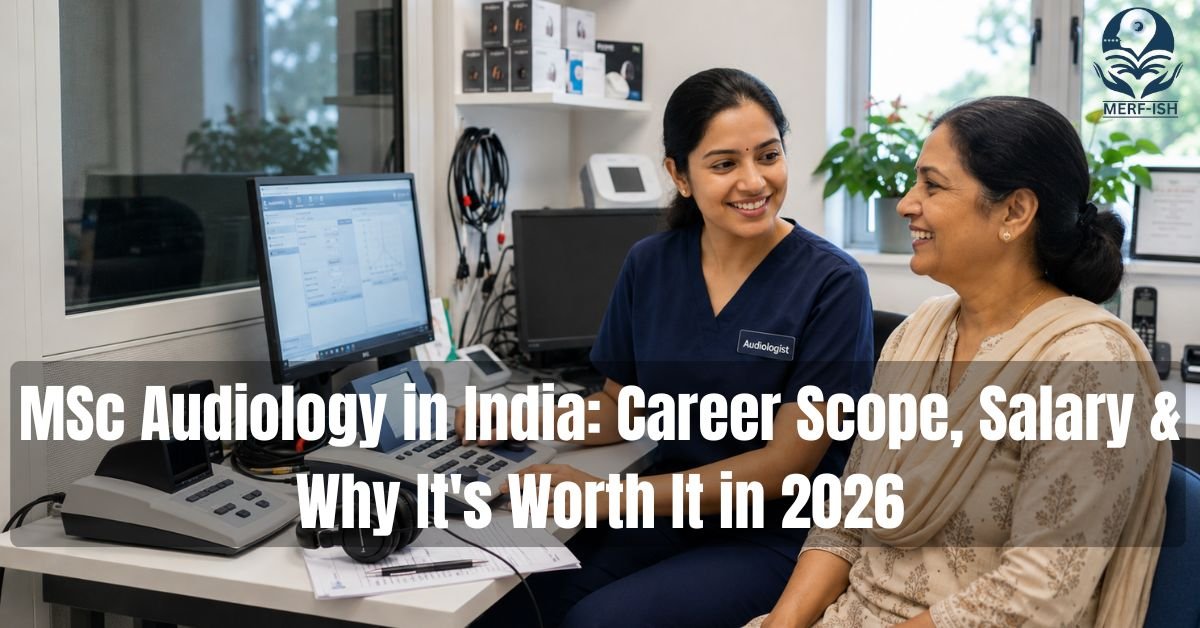
If you’ve just completed your BASLP or B.Sc. (Speech & Hearing), you’re probably wondering what comes next. MSc Audiology is one of those degrees that doesn’t get talked about enough but the people who pursue it rarely regret it.
India’s healthcare system is waking up to the massive gap in audiology professionals. With over 63 million people estimated to have significant hearing loss in this country, the demand for qualified audiologists has never been higher. And yet, there’s a serious shortage of postgraduate-level audiologists who can handle complex diagnostics, vestibular rehabilitation, cochlear implant mapping, and community hearing programs.
That’s exactly the gap an MSc Audiology from a reputed, RCI-recognised institution fills. If you want to understand the full programme structure, eligibility, and what you’ll actually learn, the MERF Institute MSc Audiology page is a great place to start.
This blog breaks down the real career scope, salary expectations, and why 2026 is actually a smart time to be entering this field.
What Is MSc Audiology — And Why Does It Matter?
MSc Audiology is a two-year postgraduate programme focused on the science of hearing, balance, and related sensory disorders. It goes well beyond what undergrad covers — you’re not just learning how to conduct a basic hearing test. You’re trained to diagnose complex hearing conditions, work with cochlear implant patients post-surgery, manage vestibular (balance) disorders, interpret advanced audiological assessments, and even certify individuals for disability benefits as per government regulations.
What makes it different from an MSc SLP? While Speech Language Pathology focuses primarily on communication and swallowing disorders, Audiology is specifically about the ear — the hearing mechanism, how it fails, and how to rehabilitate it. Both are valuable. But if your interest lies in diagnostics, technology-driven interventions, and hearing science, Audiology is your lane.
In India, this programme is governed by the Rehabilitation Council of India (RCI), which means the degree has legal recognition for clinical practice and disability certification work.
Career Scope After MSc Audiology in India
This is usually the first question students ask — and rightfully so. Let’s be direct: the career scope is wide, and it’s growing.
Clinical Audiology
The most common path. You can work in hospitals (government and private), ENT departments, hearing clinics, and cochlear implant centres. Senior audiologists in large hospitals are involved in everything from newborn hearing screenings to adult hearing aid fittings and cochlear implant mapping.
Academic and Research Roles
With an MSc, you’re eligible to teach at the undergraduate level in BASLP programmes. You can also pursue a PhD in Audiology afterwards, which opens doors to research positions, faculty roles, and policy consulting. Institutions like MERF actively contribute to audiology research in South India.
Rehabilitation and Community Work
Hearing rehabilitation is a growing vertical — especially with government schemes like ADIP and early intervention mandates. Audiologists are needed in special schools, rehabilitation centres, and NGOs working with hearing-impaired children and adults.
Government and Defence Sectors
AIIMS, NIMHANS, ESI hospitals, and Indian Armed Forces all recruit audiologists. These are stable, salaried positions with structured career growth.
International Opportunities
An RCI-recognised MSc from a reputed institution is a strong foundation if you plan to move abroad. Countries like Canada, Australia, UAE, and the UK have significant demand for qualified audiologists and Indian postgraduates with solid clinical training transition well into these systems.
Audiologist Salary in India — What Can You Realistically Earn?
Let’s talk numbers, because vague answers like ‘good salary potential’ don’t help anyone make a decision.
| Experience Level | Sector | Approx. Monthly Salary (INR) |
| Fresher (0-2 yrs) | Private Hospital / Clinic | 20,000 – 35,000 |
| Mid-level (3-5 yrs) | Govt. Hospital / ENT Dept. | 40,000 – 65,000 |
| Senior / Specialist | Cochlear Implant / Research | 70,000 – 1,20,000+ |
| Faculty / Academic | Audiology College / University | 45,000 – 90,000 |
Audiologists who run their own private clinics or hearing aid dispensing centres can earn significantly more over time — especially in Tier-1 and Tier-2 cities where awareness is increasing rapidly.
Why BASLP Graduates Should Seriously Consider MSc Audiology
A lot of BASLP graduates feel uncertain after graduation. Some pivot to speech therapy. Some consider teaching. But if you had even a mild interest in the hearing science side of your undergraduate programme — the audiometry, tympanometry, OAE, ABR sessions — MSc Audiology is worth a serious look.
Here’s what the degree actually unlocks:
• Legal authority to certify hearing disability under the Rights of Persons with Disabilities Act
• Eligibility to work in cochlear implant teams — one of the fastest-growing sub-specialties in Indian ENT hospitals
• Ability to teach in any BASLP or audiology programme as a faculty member
• Pathway to PhD in Audiology for those interested in research careers
• Access to specialised vestibular rehabilitation — a niche skill with very few trained professionals in India right now
The MSc is not just a ‘next step’ — it’s a qualifier that separates clinicians from specialists.
Is 2026 a Good Time to Pursue MSc Audiology?
Short answer: yes. Here’s why.
India’s National Programme for Prevention and Control of Deafness (NPPCD) is expanding. Universal Newborn Hearing Screening (UNHS) has been rolled out in multiple states. The demand for trained audiologists to run OAE and BERA screenings in district hospitals is real. And cochlear implant surgeries — both through private hospitals and the Assistance to Disabled Persons scheme — are increasing every year.
At the same time, the number of trained postgraduate audiologists has not kept pace. That mismatch is opportunity.
For international aspirants, 2026 is also notable because Canada, Australia, and several GCC countries have introduced structured pathways for healthcare professionals with RCI-recognised Indian qualifications to get licensed faster. If you have global ambitions, getting your MSc from a well-recognised institution now positions you well.
Choosing the Right Institution: What to Look For
Not all MSc Audiology programmes are the same. Here’s what actually matters when picking a college:
• RCI Recognition: Non-negotiable. Without it, your degree has no legal standing for clinical practice in India.
• University Affiliation: Check which university the institution is affiliated to, and whether the degree is recognised by that university’s academic board.
• Clinical Exposure: Ask how many hours of clinical practice are included. Where do students complete their internship — at the institution’s own facility or at external partner hospitals?
• Research Activity: Faculty research output, published papers, and active research projects are a sign of academic quality.
• Alumni Placement: Where have past graduates ended up? Are there any cochlear implant centres, government hospitals, or international placements among alumni?
MERF Institute of Speech and Hearing in Chennai has been offering this programme with strong clinical infrastructure and RCI recognition. You can explore their full course details and eligibility on the MERF Institute Academics page.
Eligibility Criteria for MSc Audiology Admission
To be eligible for MSc Audiology in India, applicants generally need:
• A BASLP or B.Sc. (Speech & Hearing) degree from a university recognised by the Rehabilitation Council of India
• A minimum aggregate of 55% marks in the undergraduate degree
• Valid RCI registration or eligibility for the same
• Relaxations in qualifying marks may apply for SC/ST candidates as per respective university/state norms
There is no age bar for this programme. Working professionals who completed their BASLP a few years ago and want to upgrade their qualifications are equally eligible.
MSc Audiology vs MSc SLP — How to Decide
This is the most common question at the crossroads of a BASLP degree. The short version:
| MSc Audiology | MSc SLP |
| Focused on hearing and balance | Focused on speech, language, swallowing |
| Strong in diagnostics and technology | Strong in therapy and rehabilitation |
| Cochlear implant, vestibular rehab, hearing aids | Aphasia, stuttering, voice disorders, dysphagia |
| Disability certification authority in hearing | Disability certification in communication |
Choose Audiology if you lean toward ENT, technology, diagnostics, and hearing science. Choose SLP if your passion is communication disorders, paediatric language therapy, or voice rehabilitation.
Final Thoughts
MSc Audiology is not a degree you pursue because it sounds impressive — you pursue it because you want to be the person who helps a 60-year-old finally hear their grandchild’s voice clearly, or the professional who maps a cochlear implant for a 2-year-old with congenital hearing loss. It is applied, clinical, deeply human work.
The career scope is strong. The salary curve is real. And the shortage of trained postgraduate audiologists in India means the field genuinely needs more people with this qualification.
If you’re at that decision point — between continuing clinical work after BASLP or stepping into a postgraduate specialisation — the answer, for those drawn to hearing science, is fairly clear.
Explore the full details of the MSc Audiology programme, eligibility, and admission at MERF Institute MSc Audiology — or visit the MERF Institute homepage for information on all programmes offered, including B.ASLP, MSc SLP, PGDAVT, and PhD programmes.
Frequently Asked Questions (FAQs)
1. Can I pursue MSc Audiology directly after BASLP?
Yes, BASLP is the primary qualifying degree for MSc Audiology admission. You will need a minimum of 55 percent aggregate marks and a valid RCI-recognised degree. There is no mandatory work experience requirement, though some institutions may prefer applicants with clinical exposure.
2. What is the duration and structure of the MSc Audiology programme?
The programme spans 2 years, divided into semesters. It includes theoretical coursework, laboratory practicals, and mandatory clinical practicum hours. Some institutions also include a research dissertation or project component in the final semester. Check the specific programme structure with your institution before applying.
3. Is MSc Audiology recognised by RCI — and why does that matter?
RCI (Rehabilitation Council of India) recognition is legally mandatory for practising audiology in India. Without an RCI-recognised degree, you cannot register as a clinical audiologist, issue disability certificates, or work in government healthcare setups. Always verify RCI recognition before enrolling in any programme.
4. What are the job opportunities after MSc Audiology in Chennai and Tamil Nadu?
Chennai and the wider Tamil Nadu region have a strong healthcare ecosystem — AIIMS Madurai, government ENT departments, private hospital chains, cochlear implant centres, and audiology colleges all recruit MSc Audiology graduates. Given the density of medical institutions in this region, placement opportunities are above the national average for qualified postgraduates.
5. Can MSc Audiology graduates work abroad?
Yes, though additional licensing steps are typically required depending on the destination country. Countries like Canada (SAC), Australia (Audiology Australia), and the UK (RCCP/HCPC) have formal registration processes. An MSc from a reputed RCI-recognised institution in India is generally accepted as the academic foundation for these international licensing exams. Some graduates also opt for bridging programmes or supervised clinical hours before full licensure.
MERF Institute of Speech and Hearing | Chennai, India