
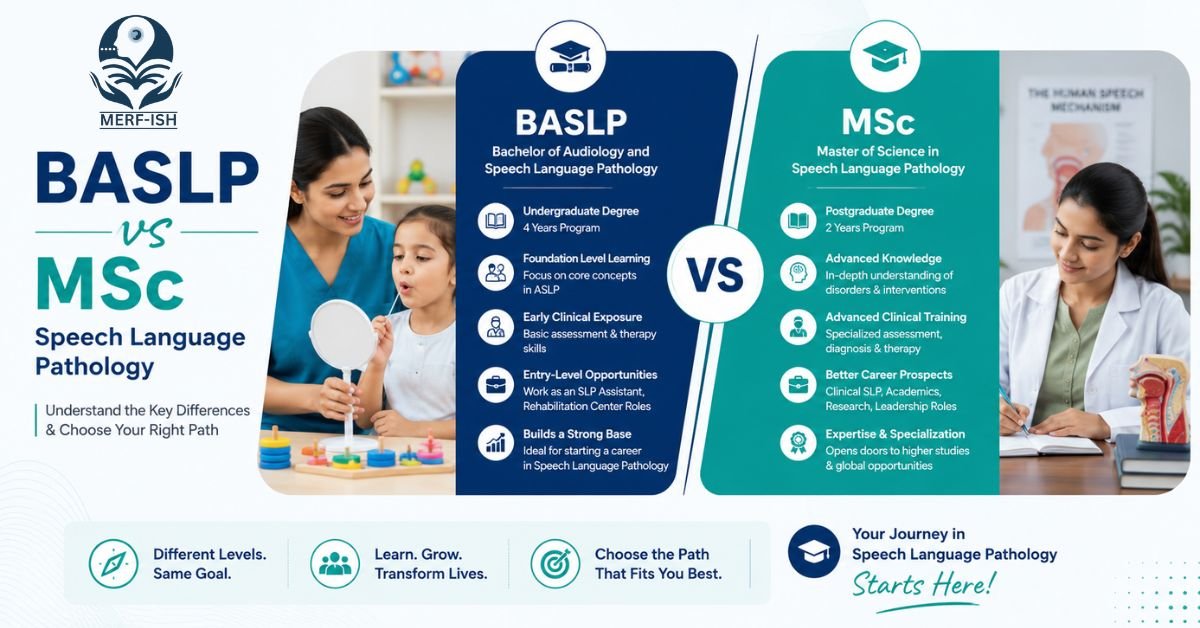
Choosing the right program in Speech Language Pathology (SLP) can shape your entire career trajectory in the healthcare and rehabilitation space. With the growing demand for certified speech-language pathologists across hospitals, schools, and rehabilitation centres in India, two programs consistently stand out: the Bachelor of Audiology & Speech Language Pathology (BASLP) and the MSc in Speech Language Pathology . But what really separates them? Which one aligns with your academic background, career goals, and personal ambitions?
This guide breaks down the key differences between BASLP and MSc SLP across every dimension — from eligibility and duration to clinical scope and career outcomes — so you can make a confident, informed decision about your future in speech therapy and audiology.
Quick Tip: BASLP is an undergraduate entry point into the field. MSc SLP is a postgraduate specialisation that deepens clinical expertise. Both are recognised by the Rehabilitation Council of India (RCI).
What Is BASLP?
The Bachelor of Audiology & Speech Language Pathology (BASLP) is a four-year undergraduate degree programme that trains students in the evaluation, diagnosis, and management of both hearing disorders (audiology) and communication disorders (speech language pathology). It is designed for students coming directly after completing their Class 12 (10+2) education with a science background.
The BASLP curriculum is broad and foundational. It covers anatomy and physiology of the ear and speech mechanism, hearing science, phonetics, language development, voice disorders, fluency disorders, and articulation. Students undergo supervised clinical internships as part of the programme, gaining hands-on experience with real patients before they graduate.
Key Highlights of BASLP
· 4-year undergraduate programme (including internship)
· Covers both audiology and speech language pathology
· Open to 10+2 science stream students
· Recognised by the Rehabilitation Council of India (RCI)
· Qualifies graduates for entry-level clinical practice
Internal Link: Explore Merfish’s official BASLP Programme Page for admission details, faculty, and curriculum specifics at our institution.
What Is MSc Speech Language Pathology?
The MSc in Speech Language Pathology is a two-year postgraduate degree aimed at students who have already completed a relevant undergraduate programme (typically BASLP or an equivalent degree). It is an advanced, research-informed program that narrows its focus exclusively to speech, language, and swallowing disorders , providing a higher level of clinical specialization than the undergraduate BASLP.
Students in the MSc SLP program engage deeply with topics such as neurogenic communication disorders, augmentative and alternative communication (AAC), pediatric language disorders, voice therapy, dysphagia (swallowing disorders), and evidence-based clinical practice. The program is ideal for those seeking roles in specialized clinical settings, research institutions, or academic positions.
Key Highlights of MSc SLP
· 2-year postgraduate degree programme
· Focused exclusively on speech-language pathology (not audiology)
· Requires BASLP or equivalent at undergraduate level
· Emphasises research, specialised clinical skills, and evidence-based practice
· Qualifies graduates for senior clinical, research, and teaching roles
BASLP vs MSc SLP: Key Differences at a Glance
The table below summarizes the primary distinctions between the two programs across the most important decision-making criteria.
| Parameter | BSLPA | MSc SLP | |
| Level | undergraduate (UG) | postgraduate (PG) | |
| Duration | 4 Years | 2 Years | |
| Eligibility | 10+2 with science (physics, chemistry, biology) | BSLPA or equivalent UG degree | |
| Scope | Audiology + Speech Language Pathology | Speech Launguage Pathology | |
| Focus | Broad, Foundational clinical training | Specialised, evidence-based practice | |
| Entry Point | Right After Class 12 | After completion BASLP/UG | |
| Career Outcome | Entry-level SLP / Audiologist | Senior SLP, Researcher, Education | |
| Research Component | Basic / Introductory | Advanced dissertation required | |
| Clinical Hours | Supervised internship (1 year) | Advanced Clinical Placement s | |
| RCI Recognition | Yes | Yes |
Eligibility Criteria
Understanding the SLP eligibility criteria is the first practical step in deciding which path suits you.
For the BASLP program, candidates must have completed their 10+2 or equivalent examination with Physics, Chemistry, and Biology as core subjects. A minimum aggregate score (typically 50% or above, varying by institution) is required. Candidates from the science stream with an interest in healthcare and communication are ideally positioned for this programme.
For the MSc SLP program, applicants must hold a BASLP degree or an equivalent undergraduate qualification in audiology or speech language pathology. Some institutions may also require an entrance examination or interview as part of the selection process.
Career Scope: BASLP vs MSc SLP
Both programmes open doors to rewarding careers in the growing field of communication disorders and rehabilitation science. However, the nature and level of roles differ meaningfully.
Graduates of the BASLP programme can work as audiologists or speech language pathologists in government hospitals, ENT clinics, special education schools, early intervention centres, and private practice. They are equipped to assess and manage a wide range of disorders including hearing loss, speech delay, language disorders, voice problems, and fluency disorders such as stuttering.
Graduates of the MSc SLP step into more senior clinical roles. Their advanced training qualifies them to work in neurorehabilitation units, tertiary hospitals, academic institutions as lecturers, and research organizations. They may specialise in areas like dysphagia management, AAC, adult neurogenic disorders (post-stroke aphasia, TBI), or pediatric language intervention.
A Genuine Word About Choosing Your Path
Here is something most comparison articles will not tell you: there is no universally “better” programme between BASLP and MSc SLP. The right choice depends entirely on where you are right now and where you genuinely want to go.
If you are a student fresh out of school, passionate about both hearing science and communication, and ready to commit to a four-year foundational journey, the BASLP at Merfish is a wonderful place to begin. It is comprehensive, clinically grounded, and opens doors you did not even know existed. Many students discover their true passion whether in audiology or SLP only during the programme itself.
If you have already completed your BASLP and feel a pull toward deeper clinical mastery, research, or teaching the MSc SLP at Merfish will stretch your thinking, sharpen your clinical reasoning, and position you for roles that genuinely change lives at a systemic level. It is not just about knowing more. It is about practising differently with greater nuance, greater empathy, and a much richer clinical toolkit.
Both paths are noble. Both are necessary. The field needs entry-level practitioners as much as it needs advanced clinicians and researchers. So ask yourself: what stage of the journey are you at today?
Which Programme Should You Choose?
Choose BASLP if: You are a Class 12 (science stream) student ready to begin your journey in speech and hearing sciences from the ground up. You want a broad clinical foundation in both audiology and SLP, and you are open to discovering your specialisation along the way.
Choose MSc SLP if: You already hold a BASLP or equivalent degree and want to specialise, conduct research, or move into advanced clinical or academic roles. You are seeking a postgraduate qualification that elevates your professional standing significantly.
If you are unsure, the natural path is to begin with BASLP and then proceed to MSc SLP this sequential route gives you the broadest possible clinical competency and the highest career flexibility in the long run.
Final Thoughts
The difference between BASLP and MSc Speech Language Pathology is ultimately a difference of stage, not of value. BASLP gives you the essential clinical foundation that every competent speech-language professional needs. MSc SLP gives you the advanced specialisation that sets apart good clinicians from truly exceptional ones.
Whether you are exploring the BASLP at Merfish as your first step into the field, or considering the MSc SLP programme to elevate your existing career — you are investing in a profession that genuinely changes lives. Every person who struggles to communicate deserves a skilled, passionate clinician in their corner. That clinician could be you.
5 Frequently Asked Questions
1. Which programmer has better salary prospects-BASLP or MSc SLP
Generally, MSc SLP graduates command higher salaries due to their advanced specialisation and postgraduate status. Entry-level BASLP professionals typically earn between ₹20,000–₹35,000/month in clinical settings. MSc SLP professionals in senior roles or academia can earn ₹40,000–₹80,000+ per month. However, experience, location, and sector (government vs. private) also heavily influence earnings.
2. Can BSLPA graduates work abroad as speech language pathologists?
BASLP is a four-year undergraduate degree, and many countries require a postgraduate qualification for full licensure. Graduates planning to work internationally — in the US, UK, Canada, or Australia — often need to complete an MSc SLP or equivalent master’s degree and meet local registration body requirements (e.g., ASHA in the US, RCSLT in the UK). Pursuing the MSc SLP significantly improves international career prospects.
3. What is the duration of BASLP and MSc SLP Programmes at merfish ?
At Merfish, the BASLP programme spans 4 years, inclusive of a mandatory clinical internship year. The MSc Speech Language Pathology programme is 2 years in duration, including advanced clinical placements and a research dissertation. Both programmes are full-time and designed to meet RCI standards.