
Introduction
Parents often notice that their child seems to understand what is being said but uses very few words to communicate. A child may follow simple instructions, understand familiar routines, and recognize what others are saying, yet still struggle to express their thoughts.
Understanding language and using language are related, but they are not the same skill. A child can have stronger language comprehension than expressive language. Understanding this difference can help parents recognize when a child may simply need more time and when professional evaluation could be helpful.
Understanding Language vs. Using Language
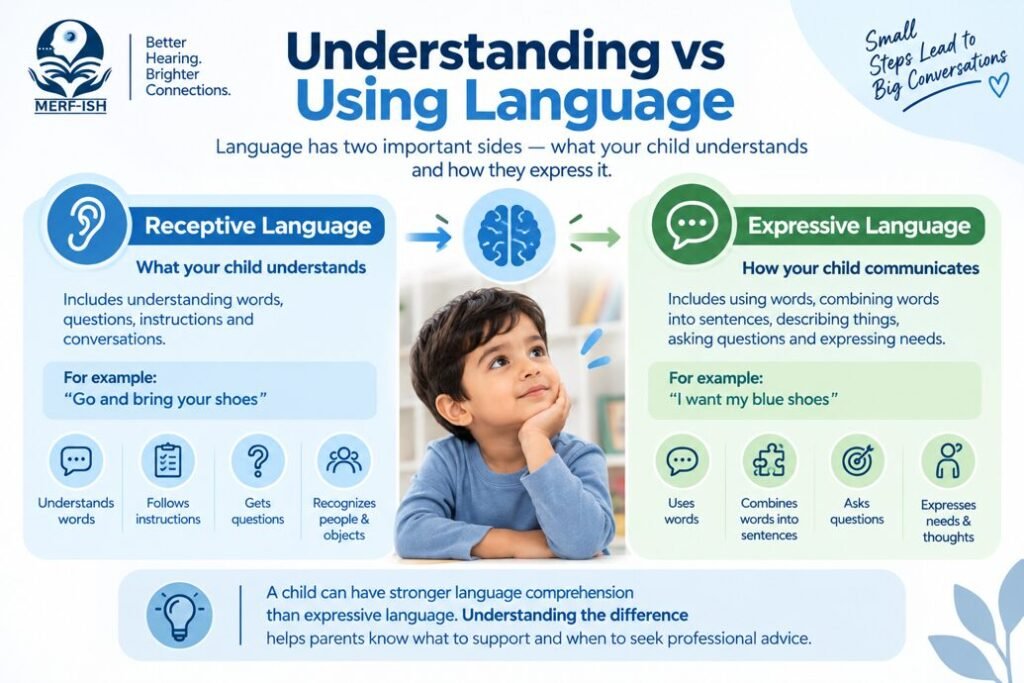
Language has two important sides.
Receptive language refers to what a child understands. This includes understanding words, questions, instructions, and conversations.
Expressive language refers to how a child communicates their thoughts. This includes using words, combining words into sentences, describing things, asking questions, and expressing needs.
For example, a child may understand “Go and bring your shoes” but may not yet be able to say “I want my blue shoes.” Their ability to understand language may be developing faster than their ability to express it.
Signs That Your Child Understands More Than They Say
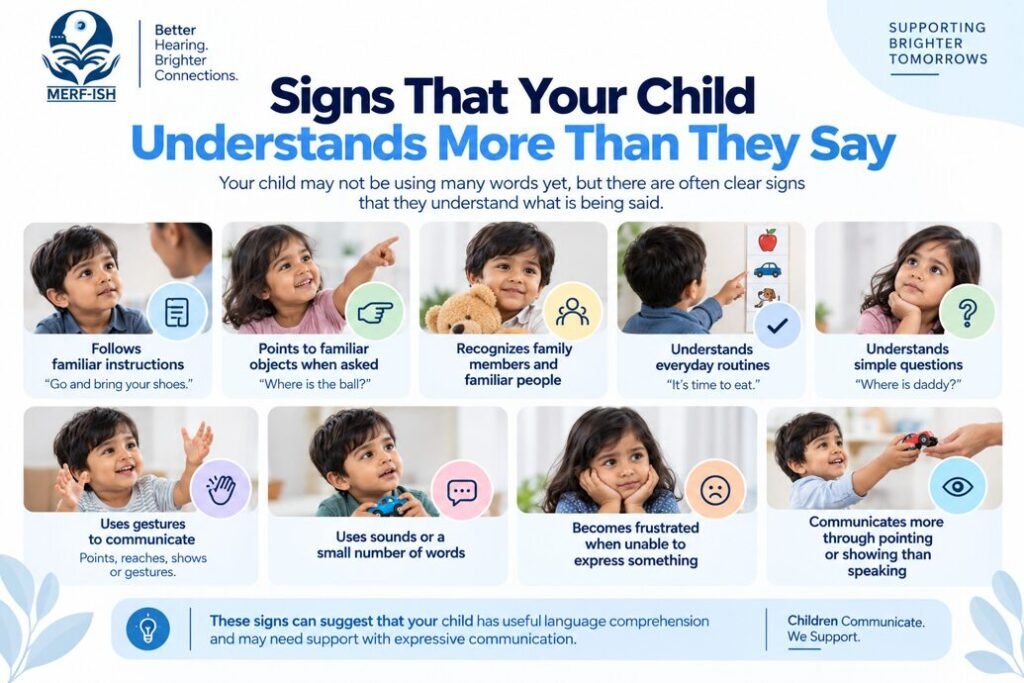
You may notice that your child:
• Follows familiar instructions
• Understands everyday routines
• Points to familiar objects when asked
• Recognizes family members and familiar people
• Understands simple questions
• Uses gestures to communicate
• Makes sounds or uses a small number of words
• Becomes frustrated when unable to express something
• Communicates more through pointing or showing than speaking
These behaviors can suggest that the child has useful language comprehension but may need support with expressive communication.
Why Might a Child Speak Very Little?
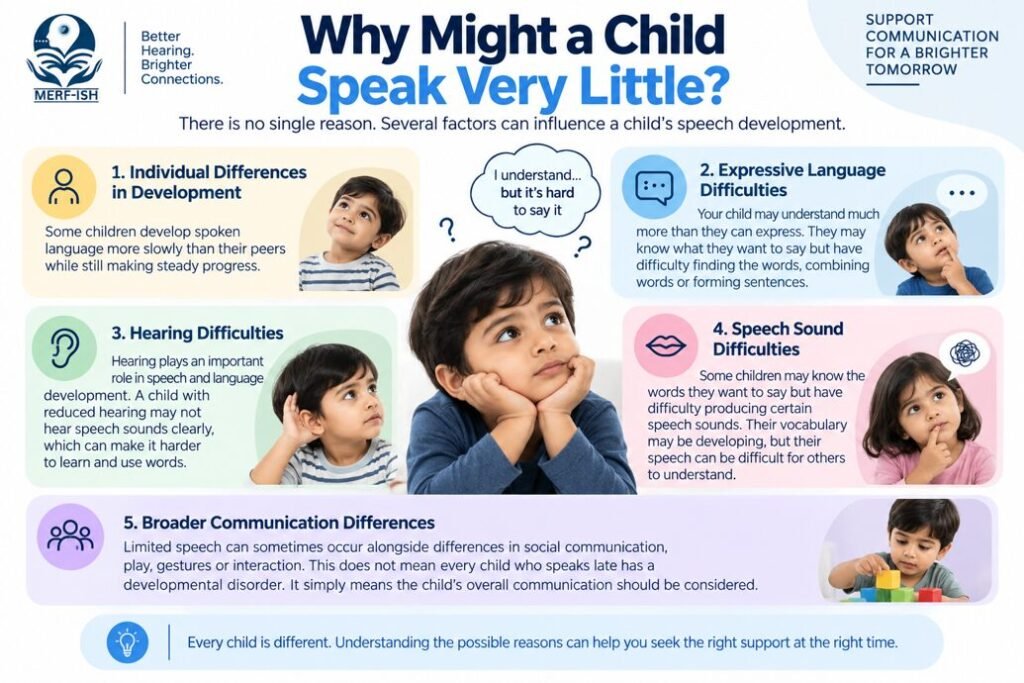
There is no single reason why a child may have limited spoken language. Children develop at different rates, and several factors can influence communication development.
1. Individual Differences in Development
Some children develop spoken language more slowly than their peers while continuing to make progress. However, it is important to look at the overall pattern of development rather than focusing only on the number of words a child uses.
2. Expressive Language Difficulties
Some children understand considerably more language than they can express. They may know what they want to communicate but have difficulty finding the right words, combining words, or forming sentences. This can affect everyday communication and sometimes lead to frustration.
3. Hearing Difficulties
Hearing plays an important role in speech and language development. A child with reduced hearing may not consistently hear speech sounds clearly, making it harder to learn and reproduce words. Even children who respond to loud sounds may have hearing difficulties that are less obvious. For this reason, hearing should be considered when a child has noticeable speech or language concerns.
4. Environmental factors
A child’s communication development can also be influenced by their environment and everyday experiences.
- Limited opportunities for communication
- Less interaction with parents, caregivers, or peers
- Limited exposure to language
- Excessive screen time
- Changes in home or school environment
- Lack of opportunities for play and social interaction
- Limited exposure to different communication situations
A supportive and interactive environment can encourage language development and help children build confidence in communicating with others.
5. Broader Communication Differences
Limited speech can sometimes occur alongside differences in social communication, play, gestures, or interaction. This does not mean that every child who speaks late has a developmental disorder. It simply means that the child’s communication should be considered as a whole.
Is Understanding Language a Good Sign?
Good understanding can be encouraging because receptive language is an important part of communication development. However, good understanding does not automatically mean that a child’s speech development will catch up without support.
Parents should consider:
• How the child communicates
• Whether vocabulary is increasing
• Whether the child combines words
• How well others understand the child
• Whether the child uses gestures and facial expressions
• How the child interacts with people
• Whether communication skills are progressing over time
Development is more meaningful when viewed as a pattern rather than a single milestone.
What Can Parents Do at Home?
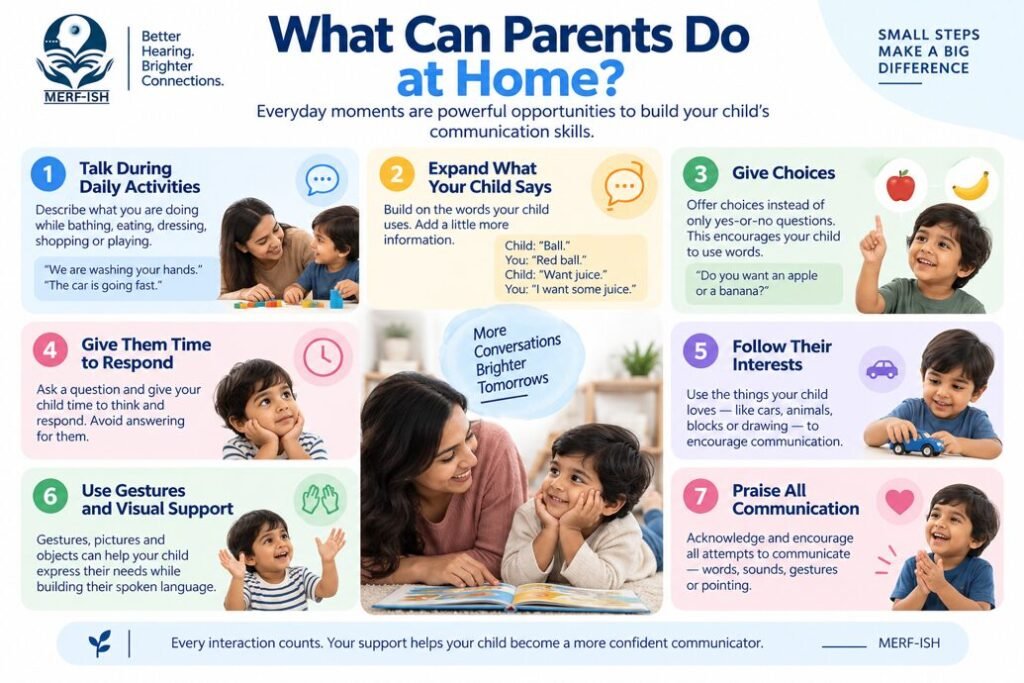
Everyday interactions provide many opportunities to encourage communication.
Talk during daily activities. Describe what you are doing while bathing, eating, dressing, shopping, or playing. For example: “We are washing your hands” or “The car is going fast.”
Expand what your child says. If your child says “Ball,” you can respond “Red ball.” If they say “Want juice,” you can model “I want some juice.” This naturally introduces slightly longer phrases.
Give choices. Instead of asking only yes-or-no questions, offer choices such as “Do you want an apple or a banana?” This encourages the child to use words to communicate a preference.
Give them time to respond. Avoid immediately answering for your child. Ask a question and give them time to process it and respond.
Follow their interests. If your child loves cars, animals, blocks, or drawing, use those interests to encourage communication. Children are often more motivated to communicate when the activity is enjoyable and meaningful to them.
When Should Parents Seek Professional Advice?
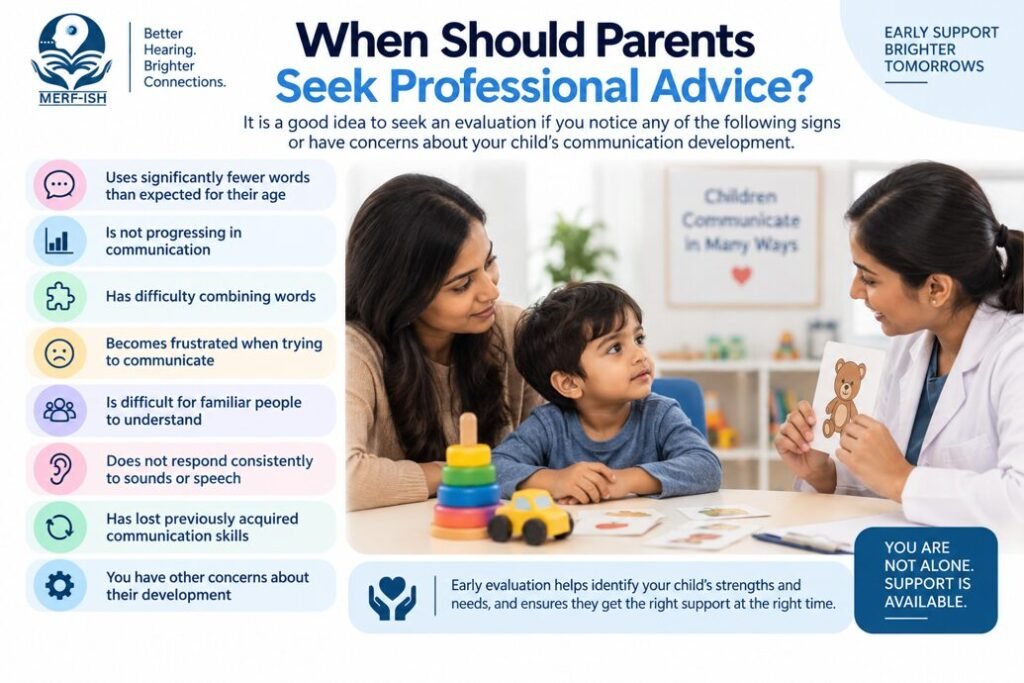
Consider seeking an evaluation if your child:
• Uses no words by 16–18 months
• Has fewer than 50 words by age 2
• Is not combining two words into short phrases (“more milk,” “go car”) by age 2
• Has vocabulary that seems stuck or isn’t growing over several months
• Shows little to no progress combining words into simple sentences by age 3
• Has difficulty answering simple questions with words, even when they clearly understand the question
• Relies almost entirely on pointing, pulling, or gesturing instead of attempting words when frustrated
• Becomes frequently frustrated or has tantrums that seem tied to not being able to express a want or need
• Avoids communication attempts altogether, or goes quiet in situations where talking would be expected
• Has lost words or phrases they previously used (regression should always be discussed with a healthcare professional promptly)
• Had little to no babbling or vocal experimentation as an infant, followed by minimal word use as a toddler
• Shows signs of hearing difficulty, such as not responding consistently to their name or needing things repeated
• Has other concerns about social communication alongside the language delay, such as limited eye contact or reduced interest in interaction
Why Is Early Evaluation Important?
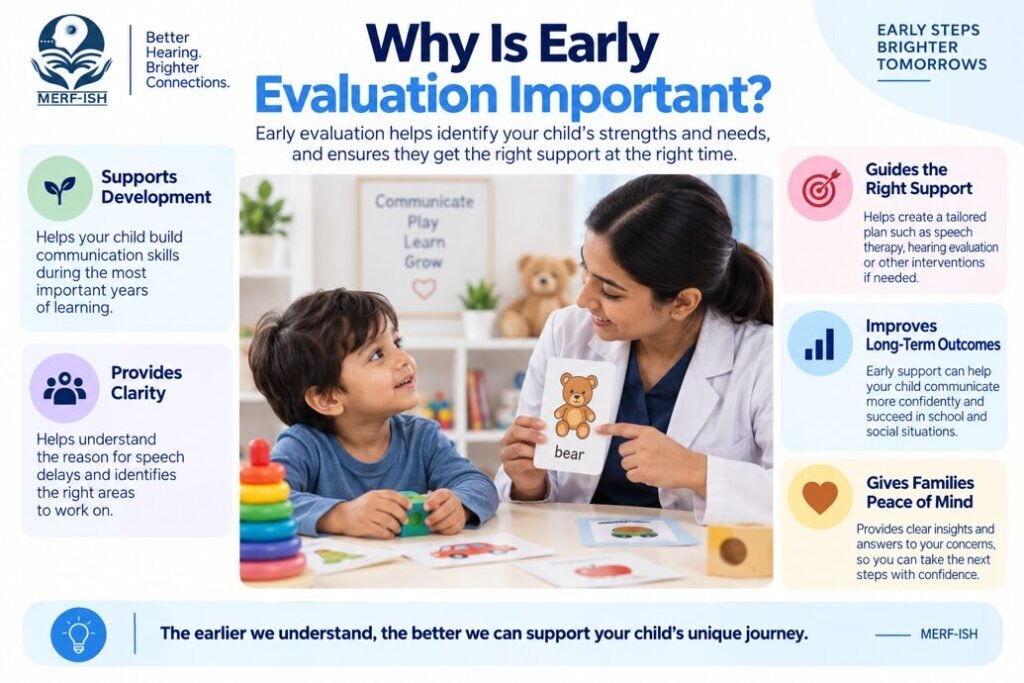
Early evaluation helps identify your child’s strengths, needs, and areas where they may need additional support. Understanding these needs early can help ensure the right support is provided at the right time.
Supports Development
Helps your child build communication skills during important stages of development.
Provides Clarity
Helps understand the reasons for speech and language difficulties and identifies the right areas to work on.
Guides the Right Support
Helps create a tailored plan based on your child’s specific needs, including speech, language, communication, or other areas.
Improves Long-Term Outcomes
Early support can help your child develop stronger communication skills and succeed in school and social situations.
Gives Families Peace of Mind
Provides clear information and answers to help families understand their child’s needs and take the right next steps.
The earlier we understand, the better we can support your child’s unique journey.
Every Child Communicates Differently
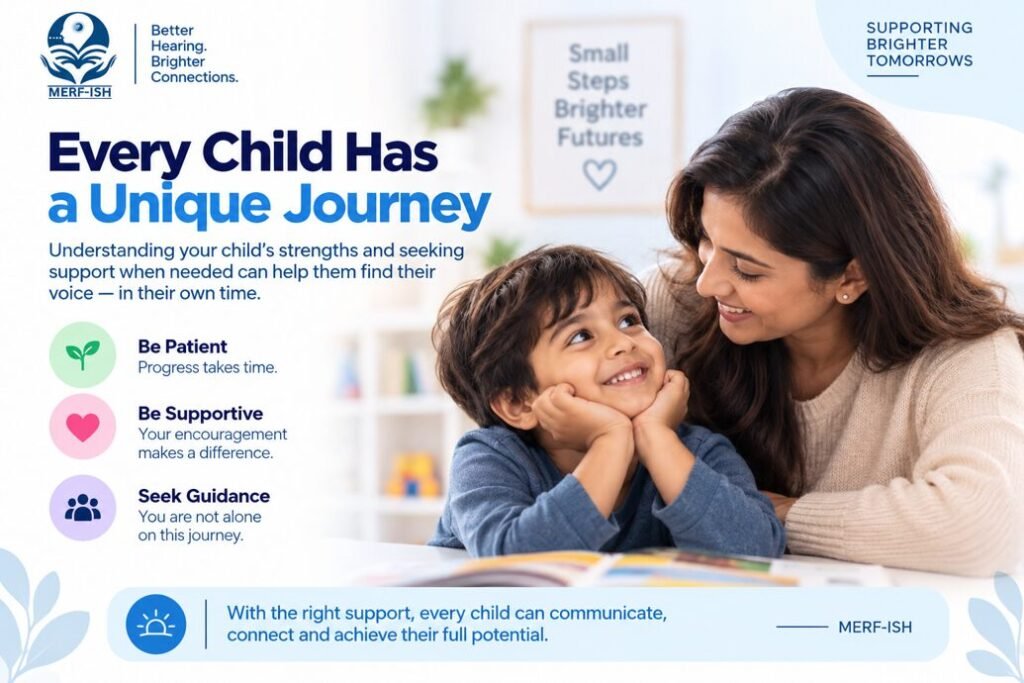
Children do not all develop speech at exactly the same pace. Some may understand considerably more than they can say, while others may have difficulty with both understanding and expressing language.
The important thing is to pay attention to progress, communication ability, and the child’s individual pattern of development.
If you are concerned that your child understands much more than they are able to express, don’t rely only on waiting and comparing them with other children. A professional assessment can provide a clearer understanding of their communication skills.
Final Thought
A child may have many things to say before they have the words to say them.
Understanding what your child can communicate—and identifying where they need support—is an important step toward helping them become a more confident communicator.