
Understanding Word-Finding Difficulties

A person experiencing word-finding difficulty may:
- Know what they want to say but be unable to produce the word
- Pause frequently during conversation
- Use words such as “thing,” “that,” or “you know”
- Describe an object instead of naming it
- Substitute one word for another
- Remember the first sound of a word but not the complete word
- Feel frustrated when the word does not come out
For example, someone may look at a key and know exactly what it is used for, but temporarily be unable to say the word “key.”
Why Does This Happen?

Finding the right word involves several language processes working together. The brain needs to identify the concept, access the associated word, and produce it in speech.
Occasional word-finding problems can happen to many people, particularly when they are tired, distracted, or under stress. However, frequent or persistent difficulty may require further evaluation.
Word-finding difficulty is particularly common in aphasia, a language disorder that can occur after damage to areas of the brain involved in language. Stroke is a common cause of aphasia, although traumatic brain injury and other neurological conditions can also cause it.
Is It a Speech Problem or a Language Problem?
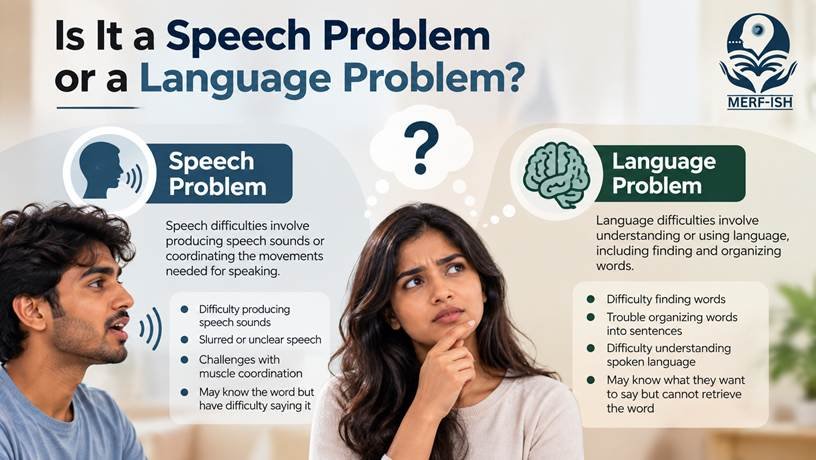
This distinction is important.
Speech difficulties involve producing speech sounds or coordinating the movements needed for speaking.
Language difficulties involve understanding or using language, including finding and organizing words.
A person may know exactly what they want to communicate but have difficulty retrieving the word. This can indicate a language-based difficulty rather than simply a pronunciation problem.
Who Can Experience Word-Finding Difficulties?

Word-finding difficulties can occur in both children and adults, but the reasons can differ.
In children, difficulty finding words can sometimes be associated with developmental language difficulties. Some children may have trouble learning new words, forming complex sentences, or finding the right words during conversation.
In adults, word-finding difficulty can occur following conditions such as stroke or traumatic brain injury. It can also occur as part of some progressive neurological conditions.
Word-finding trouble is common in older adults, but the pattern tells the SLP whether it’s part of normal aging or a sign of a neurological problem.
Important: Sudden difficulty speaking or finding words can be a sign of stroke and requires urgent medical attention.
How Is Word-Finding Difficulty Assessed?
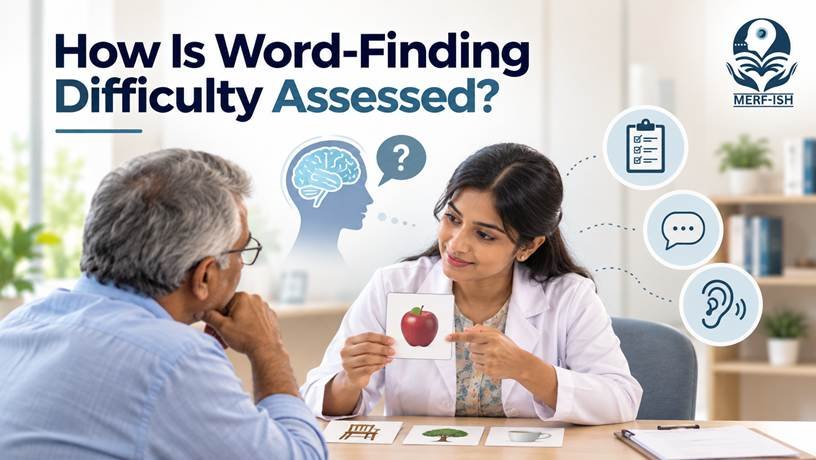
A speech-language pathologist (SLP) assesses word-finding difficulty by looking at how easily and accurately a person can retrieve words. This usually includes:
- Case history: when the difficulty started, how often it happens, and how it affects daily life.
- Naming tasks: naming pictures of objects and actions, often with standardized tests.
- Verbal fluency tasks: listing as many words as possible in a category (such as animals) or starting with a certain letter within a set time.
- Conversation and discourse samples: describing a picture, telling a story, or explaining an event, while the SLP notes pauses, fillers, vague words, and talking around a word.
- Error analysis: identifying the types of mistakes, such as wrong-but-related words, sound errors, or no response.
- Cueing: giving hints, such as the first sound or a clue about meaning, to see whether the word can be retrieved with support.
To understand the cause, the SLP may also screen related skills, including understanding spoken language, sentence formation, repetition, and reading and writing, along with memory, attention, hearing, and vision.
Can Word-Finding Difficulties Be Improved?

Support depends on the underlying cause and the individual’s communication needs.
Speech-language therapy may focus on improving word retrieval and developing strategies that make communication easier. These strategies may include descriptions, gestures, written cues, or other ways of accessing the intended word.
A speech-language pathologist can help identify communication strengths and difficulties and develop an individualized intervention plan.
Final Thought
Knowing what you want to say but being unable to find the right word can be frustrating—but it does not mean the idea is gone.
Word-finding difficulties can have different causes. If they are frequent, worsening, or affecting everyday communication, a professional speech and language assessment can help identify what is happening and what support may be appropriate.
The right words may be difficult to find—but with understanding and appropriate support, communication can become easier.